







4 min read
Water-Resistant Bearings: CJ Composite Bearings Resist Corrosion & Moisture
 Adrian Carrera
November 5, 2026
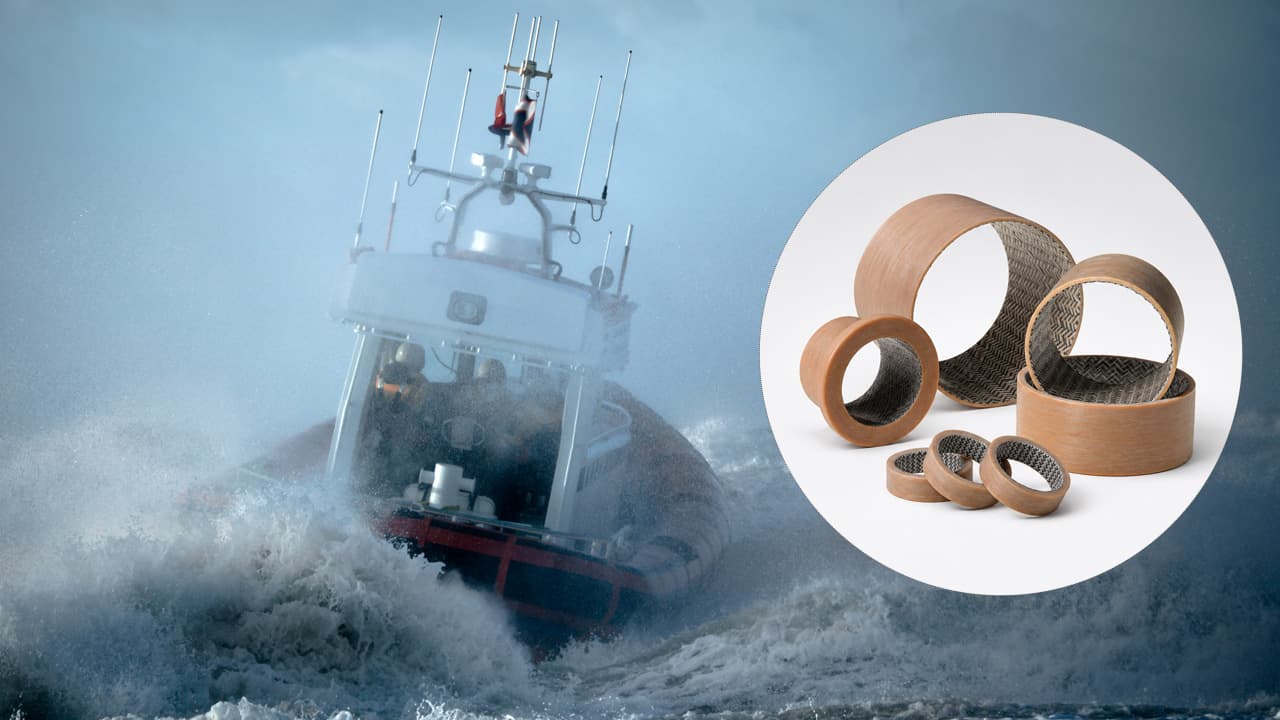
Waterproof bearings are bearings designed to operate in wet, submerged, or saltwater environments without corroding, losing lubrication, or changing dimensions from absorbed moisture. In marine applications, conventional bronze, steel, and rolling element bearings often fail early because water corrodes metal surfaces and washes out grease. CJ composite bearings from TriStar Plastics are self-lubricating and built for these conditions, making them a practical replacement for metal bearings in marine, construction, rail, and other heavy-duty equipment.
This article explains why marine environments are so hard on bearings, how CJ bearings resist water and corrosion, where they are used, and what to consider when designing a bearing for wet service.
Is Corrosion a Problem in Your Marine Bearing Application?
Marine and wet-environment bearing applications commonly raise the same questions:
- Is corrosion a problem in your marine bearing application?
- Are excessive loads or speeds a challenge?
- Need a material to resist sea spray, barnacle growth and other water hazards?
If any of these apply, the CJ bearing system might be the right fit. It has even performed on elite America’s Cup vessels.
What Are CJ Bearings?
CJ bearings are composite wound, self-lubricating sleeve bearings with a unique lubricant embedded within the surface of the liner material, which provides maintenance-free operation and eliminates the need for greasing systems. Designed as a replacement for bronze, steel, rolling element bearings and even other polymers, CJ is a simple, self-lubricating bearing solution for marine, construction, railroad and other heavy-duty applications. CJ bearings are available in standard and metric sizes, serve as a drop-in brass replacement option, and are made in the USA.
Consider CJ bearings for high-load, low-speed applications, with compressive strength up to 60,000 PSI and a maximum no-load speed of 150 feet per minute. Actual operating limits depend on load, speed, and temperature.
Why Do Metal Bearings Struggle in Marine Environments?
Metal bearings struggle in marine environments because water attacks both the bearing material and its lubrication system at the same time. The main failure mechanisms are:
- Corrosion: Steel bearings rust, and some bronze alloys can corrode in saltwater, roughening the bearing surface and accelerating wear.
- Grease washout: Water and wave action strip grease from the contact zone. A bearing that depends on regular greasing loses protection between service intervals.
- Difficult maintenance access: Submerged or hard-to-reach bearings, such as rudder or pivot bearings, are expensive and sometimes impractical to regrease.
- Environmental concerns: Grease that washes out of a marine bearing ends up in the surrounding water.
Rolling element bearings face an added risk: once water and contaminants get past the seals, the rolling elements and races can corrode and pit, often leading to sudden failure.
How Do CJ Bearings Resist Water and Corrosion?
CJ bearings resist water and corrosion through their composite construction and self-lubricating design. They address each of the failure mechanisms above in several ways:
- Corrosion resistance: The composite liner does not rust the way steel does, so the bearing surface stays intact in fresh water, saltwater, and sea spray.
- Resistance to water absorption: CJ bearings are designed to resist water absorption, which helps them hold their dimensions and running clearance in wet or submerged service.
- No grease to wash out: The lubricant is embedded in the liner surface, so lubrication is not lost when the bearing is exposed to water.
- Reduced maintenance: Eliminating greasing removes a recurring service task, which is especially valuable for bearings that are submerged or difficult to access.
Moisture resistance matters because materials that absorb water can swell, and swelling reduces running clearance. Running clearance is the gap between the bearing’s inner surface and the shaft during operation. If that gap closes, friction and heat rise and the bearing can bind. For more on how materials interact with water, see Hydrophilic, Hydrophobic, Oleophilic, Oleophobic, and Hygroscopic Defined.
Where Are CJ Bearings Used in Marine Applications?
CJ bearings perform well in these marine environments:
- Naval submarines - Fairwater plane pivot bearings
- Self-unloading barges - Loading/unloading boom pivot bearings
- Off-shore oil rigs - Spherical bearings on pipe handling devices
- Inboard/outboard motor - Stern drive pivot points and – variable pitch prop pivots
- Sail boats - Rudder bearings
- Water attractions - Underwater animatronics and other entertainment applications
Many of these are pivot or oscillating applications with high loads and slow speeds. That operating profile suits self-lubricating composite bearings, because it is hard to sustain a full grease film under slow, oscillating motion.
Beyond Marine: Construction and Rail
The same qualities that make CJ bearings effective at sea also apply on land. Construction equipment and railroad applications expose bearings to rain, washdown, mud, and high loads, and greasing every pivot point adds maintenance time and cost.
What Should Engineers Consider When Designing a Waterproof Bearing Application?
A corrosion-resistant bearing is only one part of a reliable wet-environment design. Engineers should also evaluate:
-
Shaft material and finish: The shaft is exposed to the same water as the bearing. A shaft that corrodes or pits will wear the bearing quickly, so specify a stainless or chrome-plated shaft, Rc 35 minimum, 8-16 Ra finish.
- Running clearance: Size clearance for the operating temperature range and environment, not just room-temperature conditions.
- Abrasive contaminants: Sand, silt, and debris carried by water can accelerate wear. Consider sealing or flushing where abrasives are present.
- Load and motion profile: Recommended static loads up to 35,000 psi (static compressive strength 60,000 psi at room temperature), maximum no-load speed of 150 surface feet per minute, PV limit 25,000 psi-fpm.
- Installation: Housing bore tolerances and press fit affect final bearing dimensions after installation.
Expert Note from TriStar: In marine applications, the shaft is often the overlooked failure point. A corrosion-resistant bearing running on a shaft that pits in saltwater will still wear prematurely, because the corroded surface behaves like an abrasive. When we evaluate a wet-environment application, we look at the bearing, shaft material, surface finish, and expected contaminants together, so the whole bearing system is built for the water it will see.
Learn More About CJ Bearings
Explore the benefits of CJ bearings in our video (below) or view the technical specs here. Sizes and part numbers are available in the CJ/FCJ Bearings Brochure.
Have a marine, offshore, or wet-environment bearing application? Ask the TriStar Experts for help evaluating loads, speeds, shaft compatibility, and whether CJ bearings are the right fit for your design.