








 Adrian Carrera
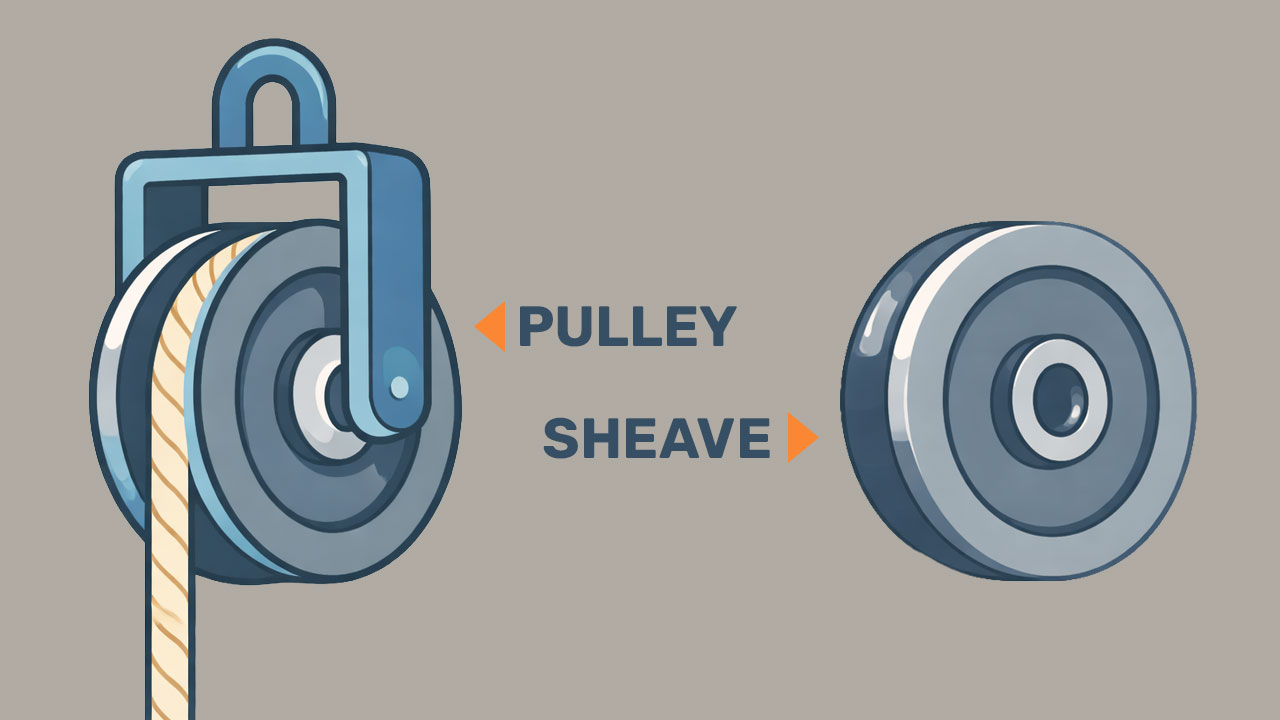
Pulleys may be one of the most recognizable machines in existence. From elementary physics classrooms to massive industrial cranes, the pulley is often introduced as one of the classic “simple machines” used to redirect force and lift loads more efficiently.
The term sheave, however, is less familiar outside of technical or industrial contexts. While frequently used interchangeably with “pulley” in everyday speech, a sheave is actually a distinct component within a pulley system.
In casual conversation, this distinction rarely matters. In engineering discussions, however, it becomes critical. Understanding the difference between a sheave and a pulley clarifies how loads are transmitted, how components wear, and how failures occur within the broader system.
In this article, we define pulleys, outline their major components, and explain the technical distinction between a sheave and a pulley (and why that difference matters when engineering pulley systems).
What is a pulley?
A pulley is a mechanical assembly designed to guide and redirect a rope, belt, or cable in order to lift, lower, or transmit force.
At its simplest, a pulley changes the direction of force. In more complex configurations (such as block-and-tackle systems) it can also multiply mechanical advantage, allowing operators to lift heavier loads with less input force.
Pulleys are employed across an enormous range of sizes and applications:
- Small rope pulleys used in window blinds or fitness equipment
- Sailboat rigging systems
- Automotive belt-drive systems
- Industrial conveyor and material-handling systems
- Massive crane and hoisting systems capable of lifting tons of material
Parts of a pulley
While pulley configurations vary by application, a typical pulley assembly may include:
- Sheave: The grooved wheel that supports and guides the rope, belt, or cable
- Bearing: The internal component that allows the sheave to rotate around a shaft or pin
- Shaft or pin: The fixed axis on which the sheave rotates
- Frame or side plates: Structural elements that hold the assembly together
- Block or housing: The outer structure that integrates the pulley into a larger system
- Thrust washers or spacers: Components that manage axial loads and protect adjacent hardware
In small consumer applications, many of these elements are integrated into a compact unit. In heavy industrial systems, each component may be engineered and specified independently to meet demanding load, environmental, and duty-cycle requirements.
Although this list appears straightforward, a pulley is not merely a collection of parts, but a complex, multi-faceted and highly dynamic mechanical system. Load enters through the rope or belt, transfers into the sheave, passes through the bearing interface, and ultimately distributes into the shaft and surrounding structure. Each interface influences how the system performs under real operating conditions.
Friction at any point in the system affects overall efficiency and wear. Excess friction at the bearing interface can increase heat generation, accelerate material degradation, and raise input energy requirements. Groove geometry influences cable tracking and wear patterns. Shaft alignment affects bearing load distribution. Even small variations in mounting tolerances can introduce side loading that changes how forces move through the assembly.
What is the difference between a sheave and pulley?
The difference is straightforward:
- A sheave is the grooved wheel itself.
- A pulley is the complete assembly that includes one or more sheaves along with bearings, shafts, and structural supports.
In many industrial settings, multiple sheaves may be incorporated into a single pulley block. These configurations are common in cranes, hoists, and marine systems where load distribution and mechanical advantage are critical.
This distinction becomes especially important when diagnosing wear or failure. A pulley may appear to be a single part, but performance issues often originate at the sheave (or more specifically, at the bearing interface inside the sheave).
Separating the terminology allows engineers to isolate variables such as groove geometry, bearing material, shaft compatibility, environmental exposure considerations, and lubrication requirements.
The Importance of Sheaves for Pulley Performance
Because the sheave directly interfaces with the rope, cable, or belt and rotates under load, its design plays a central role in overall pulley performance. For example, sheave geometry can affect cable wear, while sheave bearing selection influences friction, maintenance requirements, and service life. Material choices determine corrosion resistance, weight, and long-term reliability.
In many real-world applications, pulley failures are not structural failures of the frame but performance breakdowns at the sheave bearing level. Wear, contamination, corrosion, misalignment, and other issues often originate where the sheave rotates around its shaft. For this reason, system-level performance depends heavily on thoughtful sheave and bearing design.
The optimal solution is rarely universal. Requirements for a sheave operating in a dirty environment differ significantly from those in a marine application exposed to saltwater, or a high-speed industrial system where heat buildup and friction control are primary concerns. Load profiles, duty cycles, maintenance access, and environmental exposure all shape material selection and bearing strategy.
Effective pulley performance ultimately comes down to application-specific engineering: understanding how forces move through the system, how materials behave under real operating conditions, and how each component interacts over time.
If you're evaluating material options, troubleshooting bearing failure, or engineering a demanding sheave component, we encourage you to explore our in-depth guide to sheave bearings to learn more.
Need help evaluating performance polymers for your sheave bearing application? Ask the Experts.
