






A ferry terminal operator was struggling with grease-lubricated bronze bushings in the shore-end pivots of a vehicle linkspan—the steel ramp connecting the terminal to the vessel. Permanently exposed to seawater, silt, marine growth, and repeated wet-dry cycles, the bushings corroded, stiffened, and eventually began to bind, forcing the ramp to fight its own hinge. TriStar replaced the bronze with self-lubricating Ultracomp UC400 composite bushings, eliminating the corrosion mechanism and keeping the heavily loaded, slow-moving pivots operating freely without routine regreasing.
A High-Load Hinge in the Splash Zone
A vehicle linkspan rises and falls with every tide while carrying loaded trucks across the gap between the terminal and the ferry. Its shore-end pivots operate permanently in the splash zone, alternately submerged and exposed to air beneath layers of silt and marine growth.
On a linkspan sized for highway vehicles, the hinge pins typically measure roughly 150–200 mm, or 6–8 inches, in diameter. They rotate only a few degrees as the ramp tracks a tidal range that can exceed 10 feet twice each day. Between those slow tidal movements, the pivots experience dozens of small load reversals as vehicles load onto and unload from each ferry.
Bearing pressures reach into the low thousands of psi and spike as a loaded truck crosses the joint. Ambient temperatures can range from approximately −20°F to +100°F, while seawater wets the joint during nearly every operating cycle. The result is an unusually demanding combination: extremely slow motion, very high loading, repeated load reversals, and continuous corrosion exposure.
Why Bronze Struggles in Intermittent Seawater Exposure
Alternating immersion and drying can be more damaging to a metal bushing than continuous submersion. Each wet-dry cycle concentrates chlorides at the pin-to-bushing interface, promoting crevice corrosion in an area that cannot be readily inspected.
At the same time, silt and marine growth pack into the joint and scour away the remaining lubricant. Because the pivot moves so little, fresh grease does not redistribute effectively across the bearing surface. Instead, it remains localized until seawater eventually carries it out of the joint.
As corrosion products accumulate, the hinge becomes increasingly resistant to movement. That resistance feeds additional load back into the ramp structure and can pull the transition plates out of alignment. The condition may therefore appear to be a structural or alignment problem long before the bearing is identified as the underlying cause.
Regreasing also presents a substantial maintenance challenge. Service must be coordinated around tide windows, access equipment must be staged, and the berth may need to be taken out of operation. The operator therefore needed a pivot solution that would remain free-moving without routine access or lubrication.
Why Ultracomp UC400
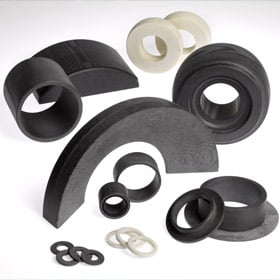
Ultracomp UC400 was developed by TriStar for demanding marine and offshore applications. This self-lubricating material uses an MoS₂-lubricated composite matrix that resists the scoring and galling that commonly damage metal bearings in corrosive service.
Because UC400 contains no metallic elements, it cannot rust, pit, or establish a galvanic cell against the steel pin. Rather than attempting to keep seawater away from the bearing interface, the material removes the crevice-corrosion mechanism itself.
Near-zero water absorption helps the bushing remain dimensionally stable through continuous wet-dry cycling. Its migratory lubricant supports a low-friction transfer film without scheduled lubrication, allowing a joint that moves only inches per day to remain free.
Ultracomp is designed for high-load, low-speed operation against an Rc 35 or harder steel pin. For an inland pivot without saltwater exposure, TriStar would typically consider graphite-lubricated Ultracomp UC200. In this application, however, the seawater and splash-zone conditions made corrosion-resistant UC400 the appropriate choice.
A Drop-In Solution for Linkspan Rehabilitation
Because linkspans are long-lived pieces of infrastructure, pivot replacements are more often completed during rehabilitation projects than during new construction. Ultracomp UC400 can be machined to match the existing bronze bushing envelope, allowing it to fit the original pin and housing during a scheduled pivot rebuild.
No structural modification is required, and the existing grease lines can be permanently removed from the maintenance program. The same material approach can also be applied to other heavily loaded, slow-moving bearing locations throughout a ferry terminal, including ramp-hoist sheaves, fender and dolphin pivots, and lift-span guide bearings.
Contact our experts to discuss replacing grease-lubricated bronze bearings with a self-lubricating solution designed for your application.