






 Adrian Carrera
We often discuss the importance of bearing service life, but what does “service life” actually mean, and how can engineers influence it during design?
According to Machine Design, bearing service life is defined as:
“The life of a bearing under actual operating conditions before it fails or needs to be replaced.”
That definition highlights an important truth: bearing life is not theoretical. It is determined by how a bearing performs in real environments, under real loads, temperatures, and duty cycles.
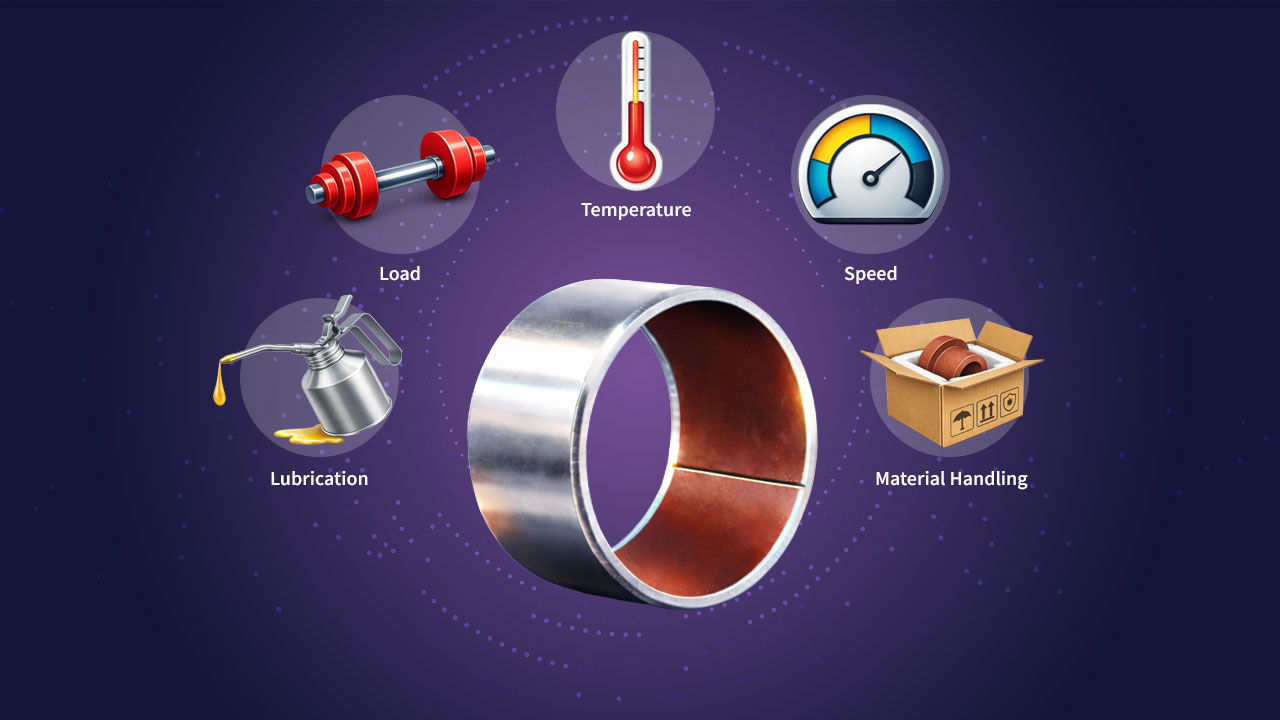
At TriStar Plastics, we evaluate bearing service life as an engineering outcome, not a guess or rule of thumb. Below are the primary factors that most directly impact how long a bearing will last, and how proper material selection and component design can extend service life dramatically.
The Primary Factors That Impact Bearing Service Life
1) Lubrication (or the Elimination of it)
Lubrication is one of the most common causes of bearing failure. Without adequate lubrication:
- Friction increases
- Heat builds rapidly
- Wear accelerates
- Bearings seize or fail prematurely
In traditional rolling element or bronze bearings, lubrication depends on maintenance schedules, accessibility, and correct grease selection. Environmental contaminants such as dust, food particles, or grit often mix with grease to form an abrasive lapping compound that shortens service life.
Self-lubricating plastic and composite bearings address this risk at the material level. Solid lubricants embedded in materials like Rulon®, Ultracomp®, CJ®, and TriSteel® continuously form a transfer film on the shaft surface, maintaining low friction without grease.
Eliminating manual lubrication removes one of the most failure-prone variables in bearing service life.
2) Bearing Load & Load Distribution
Understanding the true load profile of an application is critical to predicting bearing life.
Key considerations include:
- Static vs. dynamic loading
- Shock or impact forces
- Cantilevered or uneven loads
- Oscillating vs. continuous rotation
Underestimating load is a common design mistake. Bearings subjected to higher-than-anticipated loads experience accelerated wear, deformation, and misalignment.
Best practice is not simply to “oversize,” but to:
- Select materials with appropriate compressive strength and PV limits
- Account for misalignment tolerance>
- Design bearing geometry to distribute load evenly
Composite bearings often outperform metals here, as their elastic modulus allows them to absorb shock and tolerate edge loading without permanent damage.
3) Operating Temperature & Thermal Expansion
Temperature is a silent but powerful contributor to bearing wear. As temperature rises:
- Material properties change
- Clearances shift due to thermal expansion
- Press fits tighten or loosen
- Lubricants degrade (in metal bearings)
Matching the correct bearing material to the full operating temperature range is essential. Polymers and composites expand differently than metals, and this must be accounted for in shaft and housing tolerances.
Advanced materials such as PEEK, PTFE, and composite-based bearings maintain dimensional stability and low friction across wide temperature ranges, often outperforming greased bronze in both heat management and wear consistency.
4) Speed, Motion Type, and Alignment
Bearings must be matched not only to load, but also to:
- Surface speed (SPM or RPM)
- Motion type (rotary, oscillating, linear)
- Start-stop frequency
- Alignment accuracy
Bearings operating outside their speed or PV limits will wear rapidly, even if loads appear acceptable.
Misalignment further accelerates wear by concentrating stress on bearing edges, one reason why rigid metal bearings often fail sooner in dynamic systems.
Polymer and composite bearings tolerate misalignment and vibration far better, maintaining stable friction and predictable wear over time.
5. Material Handling, Storage, and Installation
Service life doesn’t begin at startup; it begins before installation.
Some high-performance bearing materials require controlled storage and handling. For example:
- Etched PTFE-based materials may require UV-protective packaging
- Improper storage can degrade surface chemistry before use
- Incorrect installation tolerances can negate material advantages
Engineering guidance during storage, handling, and installation is a frequently overlooked, but critical, part of maximizing service life. Read more about bearing wear.
Expert Note from TriStar: Bearing service life is not determined by a single factor, it’s the result of how material selection, load, motion, temperature, and environment interact as a system. Our engineers evaluate all of these variables together to predict wear behavior and recommend materials that deliver consistent, long-term performance in real-world conditions.
The Bottom Line: Service Life Is an Engineering Outcome
Ultimately, bearing service life improves when materials are selected for the application, not forced into it.
When properly matched:
- Bearings run cooler
- Wear becomes gradual and predictable
- Maintenance intervals extend
- Downtime decreases
- Total cost of ownership drops
TriStar’s role is to help engineers move from reactive bearing replacement to proactive bearing design.
If you’re experiencing:
- Premature bearing wear
- Overheating or seizure
- Excessive maintenance or lubrication issues
TriStar’s engineering team can help evaluate your application and recommend a plastic or composite bearing solution designed for longer service life.
Ask an Expert or explore our Bearings 101 Guide for deeper insights into bearing types, failure modes, and selection strategies.