| Home > Products > Surface Modification > Types of Techniques > Plasma |
Plasma Surface Modification & Plasma Treatments
Plasma is the fourth state of matter; a quasi-neutral cloud of ionized gas. Positive ions, negative ions, electrons, and radicals react and collide as long as an electric potential difference exists. Plasma is very reactive and can readily prime any surface for adhesion, painting, coating or printing applications.
Advantages
- Surface chemistry selectivity
- Enhanced control of treatment conditions by controlling the gas type, flow, pressure and concentration
- Management over energy frequency, wattage, and electrode configuration
- Reactive plasma treatments provide a continuum of moieties, although some adjustment to the parameters can increase or decrease the probability of one moiety over another
- Three-dimensional treatment allows any object placed inside a plasma chamber to be treated on all sides (excluding areas shielded by physical contact or masking)
- An earth-friendly process that uses no damaging solvents
Examples:
- Oxygen plasma provides the possibility of carboxyl, carbonyl, ester, ether, epoxy, hydroxyl and carbonate moieties on a hydrocarbon surface
- Nitrous plasma provides the possibility of carboxyl, carbonyl, ester, ether, epoxy, hydroxyl, urethane, amide, imine, cyano, and amine moieties on a hydrocarbon surface
- Nitrogen plasma provides the possibility of amide, imine, amine, and urethane (oxygen incorporation upon exposure to atmosphere)
Considerations
- System price is relative to system size; as the system size increases the price increases
- One must weigh the cost advantage for two smaller systems relative to one large system using throughput, yield, and budget requirements
- Throughput of a plasma system is restricted by the batch-to-batch logistics of a plasma process
- There have been attempts to make in-line plasma systems, but the manufacture price and maintenance costs usually do not justify purchasing a system for in-house treatment; very often it makes more sense to contract plasma-treatment requirements to qualified contract service companies
Plasma Application Highlight
Learn more about other Surface Modification techniques:
Benefits of Surface Modification:
- Uniform 3-D treatment
- Chemistry control
- Longer lifespan
- Roll-to-roll capability
- Corrosion-resistance
- Bondable
- Inert surface
Common Industry Applications
Medical
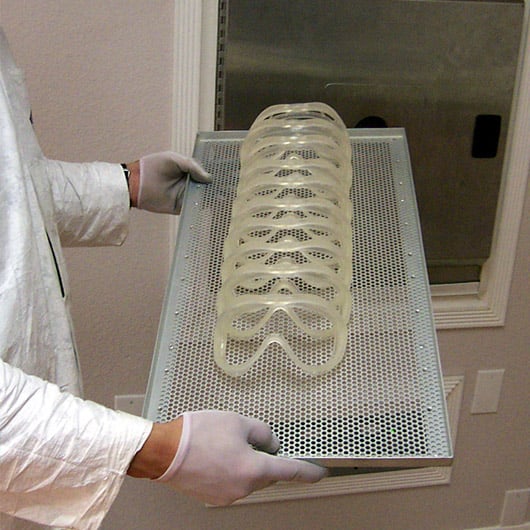
- Plasma-cleaning
- Devices including catheters, endoscopes, stents, intra-ocular lenses, etc. prior to the application of a specialty and/or lubricious coating, adhesive, or marking.
Optical
- Plasma-cleaning and/or photolysis treatments
- Materials including polycarbonate, glass, CR39, TrivexTM, PMMA, and urethane, for lenses, films, depositions, MOEMs.
Pharmaceutical
- Devices for drug delivery and storage
Biotechnology
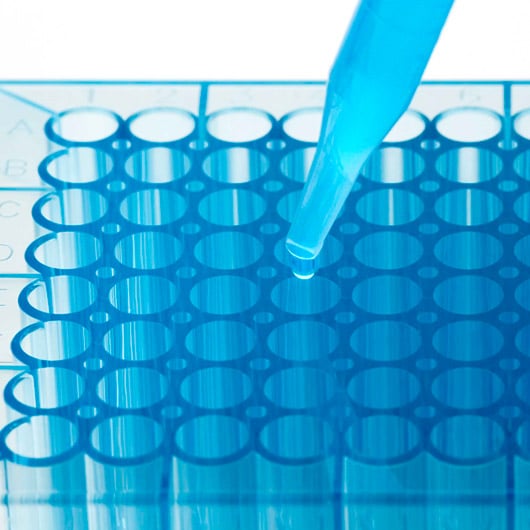
- Plasma-cleaning, functionalization and silane deposition treatments
- Micro-arrays, micro-fluidics, MEMs, etc.
Aerospace, Automotive and Commercial Products
- Improve the adhesion of gaskets and other dissimilar materials, remove "tack" from silicon devices, and increase adhesion of elastomer material to metal, polymers and other elastomers
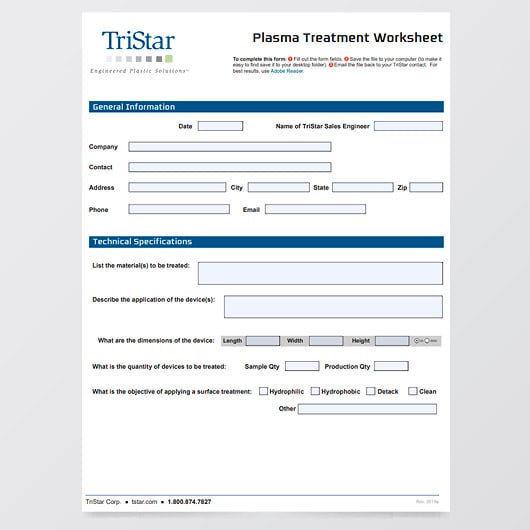
Complete our Sample Processing Form
Review our brochures for more information:
- An Introduction to Surface Modification
From cell culture trays to bonding disimilar materials, learn more about modification options. - Surface Modification Techniques
Including plasma, corona, photolysis, and parylene - Types of Failure
Adhesive, cohesive and substrate failure