






A crate and tray washer is one of those food-plant machines where caustic isn’t the cleanup — it’s part of the process. Crates travel through tanks of hot alkaline detergent and sanitizer, then rinse, hour after hour. For one processor, grease was washing rapidly from the conveyor and roller bearings, forcing frequent relubrication and short replacement cycles. Worse, displaced grease could end up in the tanks and on freshly washed crates. The processor came to TriStar looking for a bearing that could run without grease in the first place.
When the Cleaning Chemistry Is the Operating Environment
Mechanically, the application was unremarkable: moderate loads, low speeds, and continuous rotation. The challenge was that the bearings weren’t simply being cleaned by harsh chemistry, they were operating inside it. Repeated exposure to hot alkaline solution could wash out or degrade grease, shortening lubrication intervals and leaving conventional lubricated bushings vulnerable between services.
Adding grease more often could protect the bearing surfaces, but it created another problem. Displaced lubricant could migrate into the wash tanks and onto crates intended to emerge clean. In this application, the cleaner engineering solution was not to manage lubrication more aggressively, but to eliminate the lubrication requirement entirely.
Why TriSteel PT Fits the Application
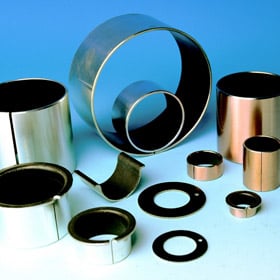
TriStar recommended TriSteel PT, a metal-backed, self-lubricating bearing system that combines a PTFE bearing surface with a sintered porous-bronze interlayer and metal backing. It is engineered to run without added lubricant, while the bronze interlayer can provide a secondary bearing surface if the PTFE liner wears through. That extra margin is useful on equipment built into a wash line, where an unexpected bearing failure can mean draining tanks just to reach the component.
The structural support of the metal backing also provides high load capacity in a compact wall section — a practical fit for conveyor and roller housings where space is limited. The PT grade’s PTFE wear surface offers excellent resistance to many aggressive cleaning chemistries and temperature capability well beyond typical wash conditions.
The Backing Is Part of the Bearing Specification
The PTFE liner is only part of the material system. In prolonged wet or chemical exposure, the bronze interlayer and metal backing also have to be compatible with the environment. TriSteel is offered in standard and metric sizes, with steel backings available in tin-, zinc-, and copper-plated configurations so the complete bearing can be specified for the actual exposure.
That makes backing selection an engineering decision, not simply a catalog lookup. Tank chemistry, concentration, operating temperature, and whether the bearing is splashed, flooded, or submerged all influence the final configuration. Looking at those conditions up front helps ensure the complete bearing system — not just the liner — is matched to the application.
Taking Grease Out of the Maintenance Cycle
For this processor, the projected result is a greaseless TriSteel PT solution that removes a recurring lubrication task, eliminates one potential source of lubricant contamination, and can extend maintenance intervals in a chemically aggressive wash environment. If grease washout or chemical exposure is creating a similar bearing problem in your equipment, contact our experts to review the application with our engineering team.
Reinforced Plane Bearings: A Technical Comparison of Liner Materials
