








Excavator quick-coupler and bucket-tilt pivots take shock on every dig cycle, often with mud, grit, and water packed around the joint. When a North American construction equipment manufacturer saw SAE 660 (C932) bronze bushings gall, loosen, and become a repeat service-and-safety concern, TriStar recommended self-lubricating CJ composite bearings for the same slow, high-load, shock-loaded oscillating duty.
What the Pivot Actually Sees
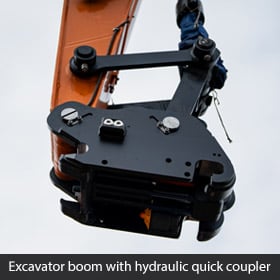
On a representative mid-size machine — roughly a 20-ton excavator — the coupler and bucket-tilt pins typically run about 65–70 mm, or 2.6–2.75 in., in diameter. They do not rotate continuously. Instead, they oscillate through the curl-and-tilt arc at just a few dig cycles per minute, with surface speeds of only a few feet per minute.
That motion is slow, but the loads are anything but gentle. Peak bearing pressures can reach into the low thousands of psi, with shock spikes on every breakout. Ambient conditions may range from roughly −20°F to +120°F over the working year. These are representative values, not data from one specific machine, but they describe the basic challenge: high load, low speed, shock, oscillation, and contamination in the same joint.
Why Greased Bronze Struggles
The weak point in the bronze pivot was not the strength of the bronze itself. SAE 660 bronze can be an effective bearing material when lubrication is maintained. The problem was that this application lives in boundary lubrication, where a very thin grease film is all that separates the pin from the bushing.
In real construction service, that film is hard to protect. Water, mud, and abrasive fines strip, dilute, and contaminate the grease faster than crews can realistically refresh it, especially when the joint is supposed to be greased every eight to ten operating hours. Once the film breaks down, the bushing and pin run metal-on-metal. Adhesive galling, pin scoring, and loss of fit follow, and the coupler begins to develop play. In a quick-coupler, that looseness is both a maintenance nuisance and a safety concern.
How CJ Changes the Equation
CJ composite bearings remove the lubrication dependency that bronze cannot escape. Strength was not the missing piece — CJ has withstood static loads in excess of 50,000 psi, or 345 MPa, at room temperature. The difference is that CJ brings its own lubrication to the joint.
During a brief break-in period, with wear on the order of 0.001 in., or 0.03 mm, the CJ braided liner transfers a film of PTFE, epoxy, and synthetic fiber onto the pin. After that transfer film is established, the wear rate stabilizes and remains low for the life of the joint. There is no grease film to maintain, contaminate, or wash away.
CJ is also well suited to the environment around the coupler. The composite does not corrode and absorbs almost no fluid, so standing water and washdown do not cause the seizure problems that can develop in lubricated metal bushings. CJ runs from cryogenic temperatures up to about +300°F, or 149°C, performs best against an Rc 50+ hardened pin, and can tolerate the misalignment that working excavator couplers commonly impose.
A Sized Drop-In for New Builds or Rebuilds
CJ bearings are specified by bore, OD, and length in thin-wall and standard-wall series, allowing them to match the original bronze dimensions and press into the existing housing and pin arrangement. That makes the swap practical for both OEM assembly and field rebuilds — no machining, no redesign, and one fewer grease point to maintain.
For similar boom, stick, bucket-linkage, or coupler pivots, TriStar’s engineering team can review the joint load, motion, pin hardness, and operating environment to recommend the proper CJ wall series and bearing size. The result is a self-lubricating pivot designed to eliminate the eight-to-ten-hour grease cycle, help keep the joint tight, and, on projected service, outlast the bronze it replaces.
If you have a high-load pivot where grease is hard to maintain, contact our experts. Our engineering team can review the joint load, motion, pin hardness, and operating environment to recommend the right CJ wall series and bearing size.
6 Reasons to Choose Filament Wound Composite Bearings
