









A robotic weld cell is a tough neighborhood for a bearing. Stray spatter, metallic fume dust, and repeated loading all challenge the fixture components that keep parts in position. An automation integrator building cells for a heavy-fabrication customer came to TriStar with a recurring problem: clamp pivots that loosened, bound, or needed attention every few weeks. Greased bronze bushings were collecting abrasive debris, while unfilled polymer replacements were deforming under clamp loads. Could we help find a better fit?
Small Movements, Heavy Demands
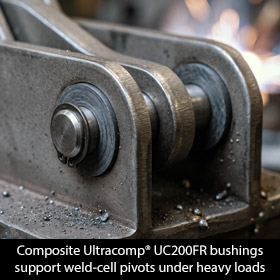
An automation integrator brings robots, welding equipment, controls, and fixtures together into a complete production system. In these cells, even the small bushings supporting the fixture pivots have a demanding job.
Consider the operating conditions typical of this application. Pneumatic clamp arms and fixture pivots ride on pins roughly 16–25 mm in diameter. Several kilonewtons of reaction force can produce bearing pressures in the low thousands of psi on a short bushing. Each pivot oscillates through just a few tens of degrees, but a 60–90-second cycle across two shifts can add up to well over 200,000 actuations annually. (These are representative figures for this application class, rather than measurements from the customer’s specific cell.)
Add the impact of heavy parts being loaded by hoist or robot, and those small movements become a demanding bearing application. Maintaining consistent clearance matters: as bushings wear or deform, the clamps can lose the repeatability needed to position parts accurately for welding.
When Lubrication Becomes Part of the Problem
Grease and metallic debris are an unfortunate combination. Spatter and fume dust captured in the lubricant create a grinding paste that scores the pin and increases clearance. Grease also leaves a combustible film near the arc. Switching to an unfilled engineering plastic eliminated the grease, but introduced gradual deformation, or creep, under sustained clamp pressure. Many such plastics also lack a flame-retardant formulation.
For this combination of conditions, TriStar identified Ultracomp UC200FR. Manufactured by TriStar for high-load, low-speed bearing applications, this composite combines polyester resins, flame-retardant additives, and graphite lubricant. The built-in lubricant allows dry operation, eliminating the grease that was trapping debris. Very high compressive strength, excellent abrasion resistance, and extremely low moisture absorption support the application’s demands. UC200FR also maintains good wear performance under misalignment and debris contamination.
Beyond the Material: Fit and Operating Conditions
Like every Ultracomp grade, UC200FR is manufactured using a prepreg process that provides consistent resin distribution and dimensional stability, helping maintain repeatable clamp positioning. Bushings can be machined to the existing dimensions for installation during a scheduled tooling refresh. The operating temperature range is −200°F to +300°F: these bushings belong on pivots near the arc, outside the direct spatter path. Spatter shielding remains good practice, and the flame-retardant formulation must be evaluated against the application’s specific fire-safety requirements.
This application brings together familiar bearing challenges: heavy loads, contamination, repeated impact, and the need for consistent positioning. UC200FR addresses those demands without grease to collect abrasive debris. If troublesome pivots or frequent bushing replacements are interrupting your production, contact our experts. Our engineering team can work with you to confirm material suitability and fit and provide supporting documentation.