







TriStar has had the pleasure of working with some of the largest civil engineering and equipment design firms in the world, but this one stood out: a European OEM designing a turnkey fiber-cement plant for Southeast Asia, built around massive autoclaves that had to run reliably for years once installed. Our job was to develop thermal expansion plates and cradle support bearing pads for these autoclaves—supporting loads up to 130,000 lbs per unit in a hot, humid environment where access after installation is limited.
The Process Behind the Pressure
Fiber cement starts as a slurry of Portland cement, cellulose fibers, sand, and water. It’s pressure-formed into siding or corrugated panels, then finished in autoclaves that remove water and cure the product into a dry, strong final panel. That last step is where heavy equipment, thermal movement, and sliding interfaces all meet.
Where Typical Bearing Pad Choices Start to Struggle
The pads had to handle extreme compressive loads while resisting vibration, abrasion, and long-term wear. They also needed stable performance through temperature swings and high humidity. And because these pads end up in hard-to-reach locations, long-term durability was critical.
We initially looked at bonded Rulon® or Fluorogold® options, similar to what we’ve used successfully on pipeline stand and tank farm sliding supports. But the load per pad in this design was high enough that we wanted more margin.
The Solution: Ultracomp UC300AX for High-Load, Low-Friction Sliding
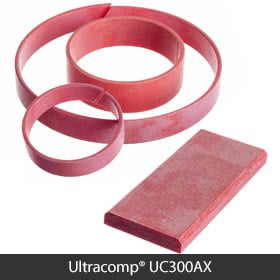
After reviewing the installation conditions and expected movement, we selected Ultracomp UC300AX for the sliding bearing pads. UC300AX is a high-load, low-friction, self-lubricating material designed for long-life performance with no maintenance, and it includes a proprietary anti-abrasion additive to improve wear resistance in demanding service.
Each autoclave used upper sliding pads and lower stationary pads, with 18 pads per unit across 12 autoclaves.
A Repeatable Approach for Heavy Sliding Applications
This project is a good example of how we approach sliding and thermal expansion supports: define the real loads and motion, identify the likely wear mechanisms, and choose a material that gives long-term stability—not just “it fits on paper.”
If you’re working on a sliding support or thermal expansion interface—light-load or extreme-load— we encourage you to contact our experts with your application details.