| Home > Products > Surface Modification > Types of Techniques |
Surface Technology and Modification
Comparison of Techniques From the Industry Leader
Considered to be part art and part science, surface modification is a growing trend in manufacturing and research, as industries seek to alter polymer surfaces for better adherence and bonding. At TriStar, we are proud to have partnered with leading manufacturers of medical, optical and pharmaceutical devices, as well as automotive, aerospace, and semiconductor components, to enhance performance of their materials.
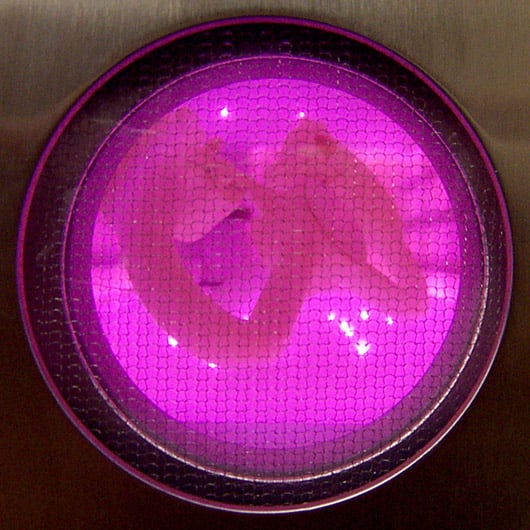
Common techniques of surface modification include plasma, corona, photolysis, and parylene each offering unique strengths and advantages.
Let SMD experts show you the advantages in cost, manufacturing and yield that you can realize with choosing the proper modification technique for your application.
TriStar’s Surface Modification Division (SMD) can help you:
- Appraise polymer type
- Analyze process requirements
- Evaluate throughput demands
- Review budgets and timelines
- Present a cost-effective solution
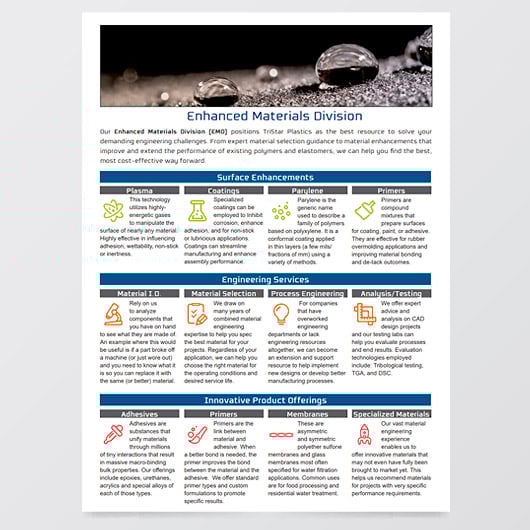
Download Surface Modification Brochure.
Read more about our surface modification techniques:
Benefits of Surface Modification:
- Uniform 3-D treatment
- Chemistry control
- Longer lifespan
- Roll-to-roll capability
- Corrosion-resistance
- Bondable
- Inert surface
Common Industry Applications
Medical
- Plasma-cleaning
- Devices including catheters, endoscopes, stents, intra-ocular lenses, etc. prior to the application of a specialty and/or lubricious coating, adhesive, or marking.
Optical
- Plasma-cleaning and/or photolysis treatments
- Materials including polycarbonate, glass, CR39, TrivexTM, PMMA, and urethane, for lenses, films, depositions, MOEMs.
Pharmaceutical
- Devices for drug delivery and storage
Biotechnology
- Plasma-cleaning, functionalization and silane deposition treatments
- Micro-arrays, micro-fluidics, MEMs, etc.
Aerospace, Automotive and Commercial Products
- Improve the adhesion of gaskets and other dissimilar materials, remove "tack" from silicon devices, and increase adhesion of elastomer material to metal, polymers and other elastomers
Complete our Sample Processing Form
Review our brochures for more information:
- An Introduction to Surface Modification
From cell culture trays to bonding disimilar materials, learn more about modification options. - Surface Modification Techniques
Including plasma, corona, photolysis, and parylene - Types of Failure
Adhesive, cohesive and substrate failure