Toll Free: (800) 874-7827
Home > Products > Surface Modification

Surface Modification | Experience the TriStar Advantage

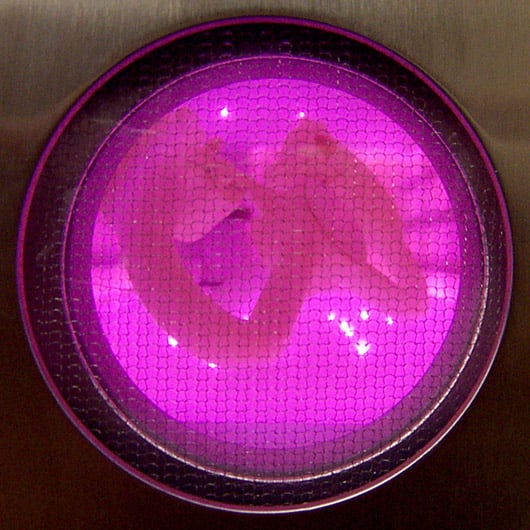
Surface Modification is the combination of physics and chemistry working together to modify materials to enhance surface properties.  TriStar’s Surface Modification Division (SMD)  has pioneered all new techniques to address your toughest surface challenges.   Click here to learn more.

Our services include:

  • Surface treatments
  • Contract review
  • Analytical assistance
  • Surface modification equipment

Surface modification can improve adhesion properties, micro-clean, functionalize (amine, hydroxyl, carboxyl, etc.), produce biocompatibility, create permanent moisture, and produce hydrophobic characteristics. 

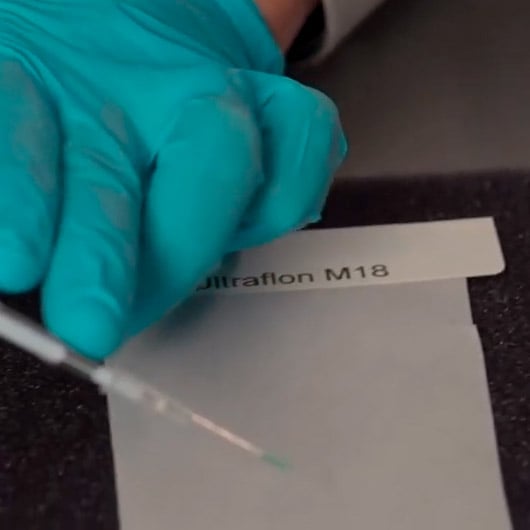
When your questions are: “How best to adhere this paint?” or “How to bond two dissimilar materials?”  Just ask the experts for a complete analysis.

Benefits of Surface Modification:

  • Uniform 3-D treatment   
  • Chemistry control                   
  • Longer lifespan
  • Roll-to-roll capability
  • Corrosion-resistance
  • Bondable
  • Inert surface

Common Industry Applications

Medical

  • Plasma-cleaning
  • Devices including catheters, endoscopes, stents, intra-ocular lenses, etc. prior to the application of a specialty and/or lubricious coating, adhesive, or marking.

Optical

  • Plasma-cleaning and/or photolysis treatments 
  • Materials including polycarbonate, glass, CR39, TrivexTM, PMMA, and urethane, for lenses, films, depositions, MOEMs.

Pharmaceutical 

  • Devices for drug delivery and storage

Biotechnology

  • Plasma-cleaning, functionalization and silane deposition treatments 
  • Micro-arrays, micro-fluidics, MEMs, etc.

Aerospace, Automotive and Commercial Products

  • Improve the adhesion of gaskets and other dissimilar materials, remove "tack" from silicon devices, and increase adhesion of elastomer material to metal, polymers and other elastomers

Complete our Sample Processing Form

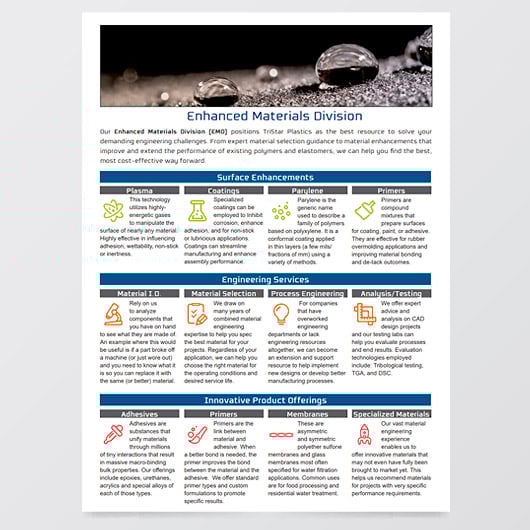
Review our brochures for more information:

Read more about our surface modification techniques: